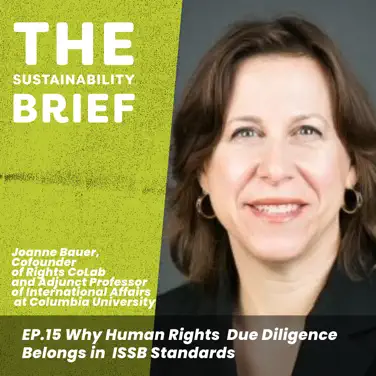
Rights CoLab co-founder Joanne Bauer was featured in the latest episode of The Sustainability Brief podcast, where she discusses why human rights due diligence (HRDD) belongs in the International Sustainability Standards Board (ISSB) framework and what this shift means for investors, companies, and global sustainability reporting.
Podcast host Aleksandra Anna Lasota asks Joanne to summarize the findings of Rights CoLab’s recent report, A Roadmap for Integrating Human Rights Due Diligence into ISSB Standards, to explain why HRDD is no longer a peripheral issue, but a core element of financial risk management.
The discussion unpacks how ISSB’s existing standards already contain important building blocks for HRDD, particularly through IFRS S1 and sector-specific SASB metrics. It also highlights the gaps that prevent investors from seeing a complete picture of how companies identify, manage, and address human rights risks across their value chains.
Key insights from the episode include:
- Why HRDD is financially material: Investor divestments, stewardship policies, and forced labor enforcement actions increasingly demonstrate that human rights risks translate into measurable financial exposure.
- Where ISSB already aligns: Many ISSB and SASB disclosures are already impact-oriented and compatible with due diligence thinking, even within a financial materiality framework.
- What remains missing: Core elements of HRDD, especially remediation and meaningful engagement with affected stakeholders, are largely absent, resulting in incomplete risk disclosure.
- A practical path forward: By explicitly aligning ISSB disclosures with the OECD Due Diligence framework, ISSB can strengthen its global baseline and improve interoperability with frameworks like The Corporate Sustainability Reporting Directive (CSRD) and the Global Reporting Initiative (GRI).
Why this matters
ISSB standards are shaping how capital markets worldwide assess sustainability-related financial risk. Integrating human rights due diligence more clearly is not about expanding reporting for its own sake, but about ensuring that the risks companies already face are visible where they matter most: in investor decision-making, corporate governance, and regulatory oversight.